
Don’t Judge a Part by Its Color

A white, powdery coating on a molded rubber part may look like a defect. Yet rubber bloom can be an expected result of compound design—or a sign that surface characteristics need attention. The distinction depends on what has migrated to the surface and whether it affects the component’s intended performance.
What Is Rubber Bloom?

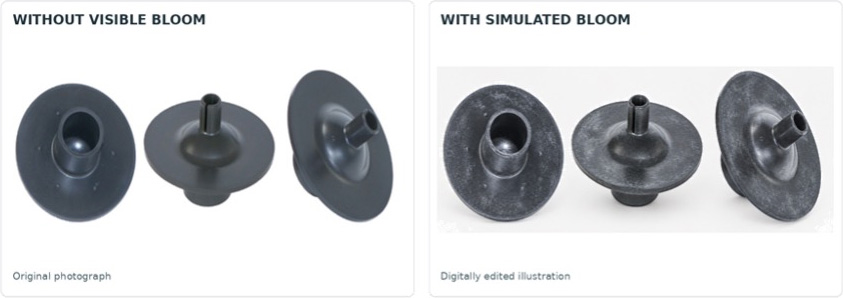
Rubber bloom occurs when ingredients within a rubber compound migrate to the surface and accumulate there. It can appear as a white or gray haze, fine powder, crystalline deposit, or waxy film, either shortly after molding or during storage. Appearance alone cannot identify the substance or determine whether the part is acceptable.

Figure 1 — Caption: Molded rubber parts without visible bloom (left) and with digitally simulated bloom (right). The image at right is an illustration, not a documented example of bloom on these parts.

Why Does Rubber Bloom Occur?

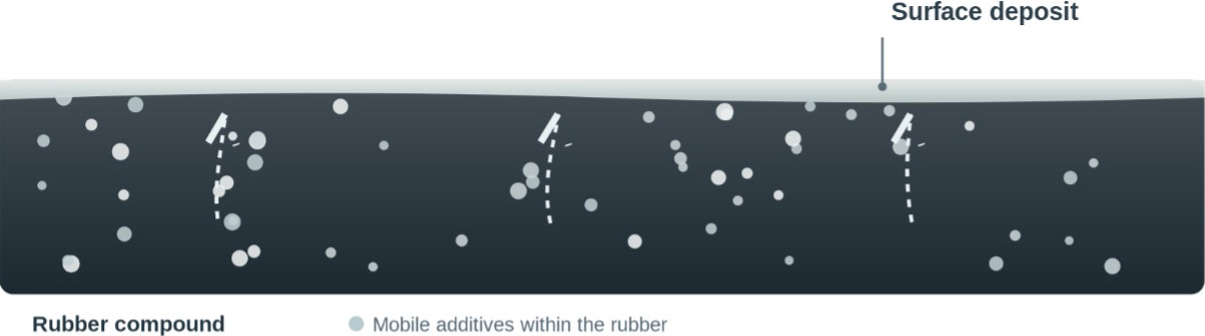
Rubber compounds contain more than the base elastomer. Curing agents, accelerators, protective waxes, antioxidants, and processing aids are selected to achieve specific manufacturing and performance properties. Some ingredients can move toward the surface because of their concentration, compatibility with the polymer, or changes in temperature and storage conditions.

  • Intentional bloom: Certain protective waxes migrate to form a surface barrier against ozone. Some purpose-selected lubricating additives can also reach the surface to reduce friction.
  • Unwanted bloom: Ingredients such as certain curing-system residues or processing aids may create deposits that interfere with appearance, cleanliness, or secondary manufacturing operations.
Figure 2 — Simplified illustration of ingredient migration within a rubber compound and the formation of a surface deposit.

Why Engineers Care

For OEM engineers, the question is not simply whether bloom is visible. It is whether the deposit changes a surface property that matters to the application.

  • Ozone resistance: An intentionally formed wax layer can help protect certain rubber components from ozone exposure.
  • Bonding and finishing: Unwanted deposits may interfere with adhesive bonding, coating, or printing.
  • Assembly and sealing: Surface films may alter friction or installation behavior; their effect on sealing must be evaluated against the part’s actual performance requirements.
  • Appearance and cleanliness: Even a mechanically sound part may be unacceptable where cosmetic consistency or contamination control is specified.

The key distinction: A protective film may be desirable on one component and unacceptable on another, depending on the engineering requirements.

Bloom, Bleeding, or Contamination?

Not every surface film is bloom. A dry or waxy deposit may indicate blooming, while a wet or tacky film caused by migrating liquid ingredients is often described as bleeding. Mold-release residue, packaging transfer, or other external contamination can also resemble bloom. Visual inspection alone cannot reliably distinguish these conditions.

How Is Bloom Evaluated and Controlled?

Evaluation begins by comparing affected and unaffected parts and reviewing the formulation, curing process, storage history, and intended use. When necessary, laboratory analysis can help identify the deposit. Any corrective action should also be checked against the component’s functional requirements.

If bloom is unwanted, changes to additive selection or concentration, processing, or storage may help reduce it. Cleaning a deposit from the surface may not stop it from returning. Conversely, eliminating intentional bloom may remove a useful protective or lubricating function.

How Rahco Rubber Can Help

Through its Rubber Compound Development and Quality Assurance capabilities, Rahco Rubber helps OEM engineers balance material performance, manufacturing requirements, and finished-part characteristics. Evaluating bloom as part of the overall application helps determine whether it should be minimized, accepted, or deliberately designed into the compound. The goal is not simply a clean-looking part, but a custom molded rubber component that performs as specified.

For more information, contact us today via email or phone at 847-298-4200.