
Understanding Stiffness and Resistance to Stretching in Rubber Compounds

Modulus describes a material’s resistance to deformation under force. In rubber testing, it commonly refers to the tensile stress required to stretch a rubber specimen to a specified percentage of its original length.

A higher-modulus rubber compound resists stretching more strongly, while a lower-modulus compound stretches more easily. Modulus is an important consideration in selecting or developing rubber compounds to meet specific performance requirements.
How Is Rubber Modulus Measured?

Unlike rigid materials, rubber exhibits nonlinear stress–strain behavior, meaning its resistance to stretching changes with elongation. As rubber stretches, its long polymer chains rearrange and become more oriented, potentially increasing resistance to further deformation. For this reason, engineers commonly specify modulus at particular elongations rather than relying on a single stiffness value.

Measurement Meaning
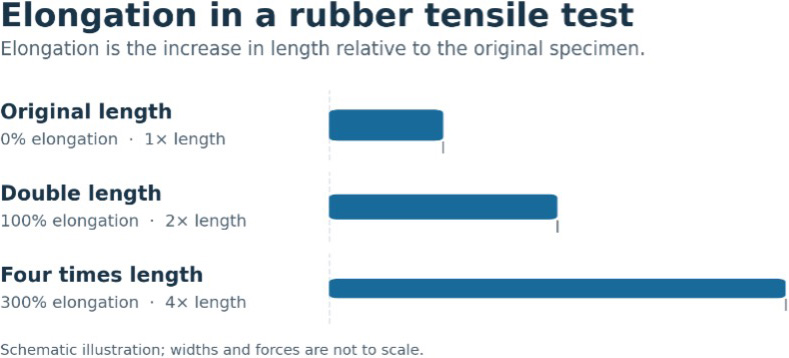
100% Modulus (M100) Stress required to stretch rubber to twice its original length
200% Modulus (M200) Stress required to stretch rubber to three times its original length
300% Modulus (M300) Stress required to stretch rubber to four times its original length
Figure 1. Illustration of a rubber specimen at its original length, 100% elongation, and 300% elongation.

Unlike Young’s modulus, which describes the slope of the stress–strain curve, these measurements represent the stress at specified elongations. Modulus values are typically expressed in pounds per square inch (psi) or megapascals (MPa) and measured in accordance with ASTM D412.

At Rahco Rubber, an ADMET Universal Testing System measures the force and elongation of rubber specimens during tensile testing. These measurements provide the data needed to evaluate modulus at specified elongations and assess compound performance against engineering requirements.

Why Engineers Care

Modulus is an important factor in determining how a rubber component will perform under mechanical stress. Engineers use modulus specifications to evaluate and compare rubber compounds, helping ensure that the selected material provides the appropriate balance of flexibility, load-bearing capability, dimensional stability, and resistance to deformation.

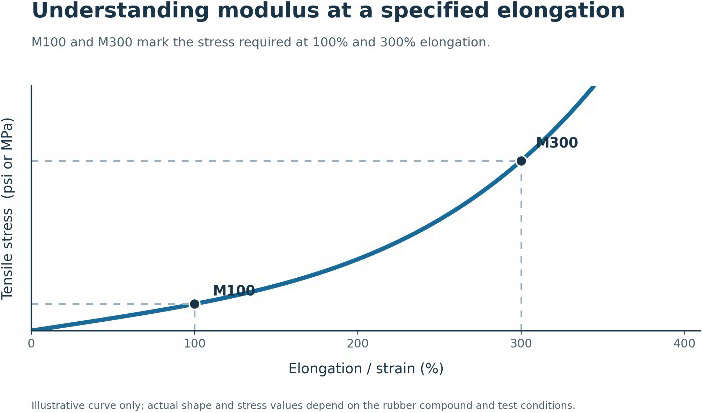
A rubber compound’s stress–strain curve illustrates how resistance changes during stretching. Strain represents the degree of elongation, while stress represents the applied force per unit area. A steeper curve indicates greater resistance to additional stretching, a behavior that can occur at higher elongations.

Figure 2. Illustrative stress–strain curve showing the tensile stress required at 100% and 300% elongation. Actual curves vary by compound and testing conditions.

The importance of modulus varies by application:

  • Seals and Gaskets: Require sufficient flexibility to conform to mating surfaces while maintaining sealing performance. High-pressure applications, including hydraulic and oil and gas equipment seals, may require higher-modulus compounds to help resist excessive deformation and extrusion.
  • Engine Mounts and Structural Bushings: Must balance stiffness, load-bearing capacity, and vibration isolation. Higher-modulus compounds may be appropriate where greater load support and resistance to deformation are required.
  • Shock and Vibration Isolation Components: Require carefully controlled stiffness and damping characteristics to absorb energy while maintaining component stability.

By specifying modulus at defined elongations, engineers can make consistent comparisons between compounds and evaluate their suitability for different applications. Actual component performance also depends on part geometry, operating conditions, and other material properties.

What Determines Rubber Modulus?

Several factors influence the modulus of a rubber compound, including:

  • Polymer Type: Different elastomers have inherently different mechanical properties.
  • Reinforcing Fillers: Materials such as carbon black can increase stiffness and resistance to deformation.
  • Crosslink Density: The degree of vulcanization influences the rubber’s elastic network and mechanical response.
  • Reinforcement: Fibers and other reinforcing materials can increase stiffness in rubber composites.

Compound formulation, temperature, and testing conditions also influence measured modulus.
Although high-modulus rubber compounds are stiffer than lower-modulus elastomers, they generally remain substantially more flexible than metals or ceramics.

Modulus, Hardness, and Tensile Strength

While related, these properties measure different aspects of rubber performance:

  • Modulus: Resistance to stretching at a specified elongation.
  • Hardness: Resistance to localized indentation.
  • Tensile Strength: Maximum tensile stress a material can withstand before breaking.

Understanding these distinctions helps engineers establish appropriate material specifications. Through Rubber Compound Development and quality testing, Rahco Rubber helps OEMs develop custom rubber formulations that meet the mechanical and performance requirements of their applications.