

For OEMs, The Real Advantage Comes from Choosing the Right Domestic Manufacturer
Reshoring is moving from conversation to operating strategy for U.S. manufacturers, as OEMs increasingly look for greater control over cost, quality, lead times and supply-chain risk. For Rahco Rubber, that shift reinforces something we see every day: the value of domestic sourcing is greatest when the manufacturing itself is truly domestic.
According to the 2026 USA Reshoring Survey, conducted by the Reshoring Initiative and Regions Recruiting, 36% of OEM respondents said they had reshored or were actively executing additional reshoring, up from 29% in 2025. Another 17% were considering it.
Today’s manufacturers also appear prepared to keep investing. In fact, nearly two-thirds (63%) of OEM respondents plan U.S. capital expenditures in 2026 or 2027 to support reshoring or other domestic expansion.
However, the most interesting findings may be why OEMs are moving production closer to home — and what happens when they do.
The Reshoring Case Goes Beyond Tariffs
Among OEMs that had reshored since January 2025, 65% cited tariffs, 60% geopolitical risk, and 50% delivery time or proximity to customers as leading reasons for making the change.
Those concerns may initiate a reshoring conversation, but the operational results make an even stronger business case.
OEMs reported:
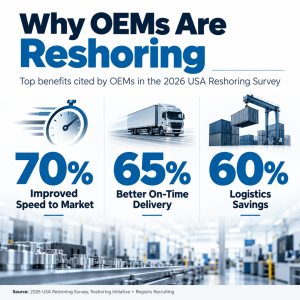
- 70% improved speed to market
- 65% better fulfillment and on-time delivery
- 60% logistics savings
- 40% inventory optimization or lower carrying costs
Across the survey, positive operational impacts averaged roughly twice the negative impacts.
At the same time, more OEMs are looking beyond unit price when evaluating domestic versus offshore production. The share using Total Cost of Ownership (TCO) increased from 30% in 2025 to 40% this year.
For strategic decision-makers, this matters because piece price rarely captures the entire cost of manufacturing a component.
For OEMs relying on precision rubber components, that calculation can be even more consequential. Material performance, tooling, quality consistency, engineering support and dependable supply can directly affect the performance of the finished product.
Freight, inventory, lead time, quality, rework, engineering responsiveness, supply interruptions and the cost of carrying additional safety stock all affect what an offshore component ultimately costs.
Reshoring Alone Doesn’t Guarantee Success
Reshoring can create real advantages, but simply moving production back to the United States does not guarantee a better outcome. OEMs still need the right manufacturing partner, with the capabilities to manage the transition, maintain quality and improve the way the component is produced.
The research also shows where the challenges remain. 35% of OEMs identified increased labor and overhead costs as a negative impact of reshoring, while another 35% cited gaps in domestic component availability. Another 20% reported supply-chain transition friction.
Overall satisfaction also declined. 65% of OEMs reported being satisfied with their reshoring results in 2026, compared with 96% in 2025. Importantly, the research notes that this does not mean reshoring is failing. Operational positives still outweighed negatives, but OEMs are encountering labor costs, vendor gaps and the realities of transitioning productions.
That makes the choice of domestic manufacturing partner especially important.
It also highlights a critical distinction between being domestically supplied and being domestically produced. A supplier may operate in the U.S. while still relying on offshore manufacturing, leaving OEMs exposed to many of the same lead-time, logistics, quality and supply-chain dependencies they are trying to reduce.
At Rahco Rubber, true domestic manufacturing brings material expertise, engineering, molding, testing, automation and value-added manufacturing capabilities together close to the customer.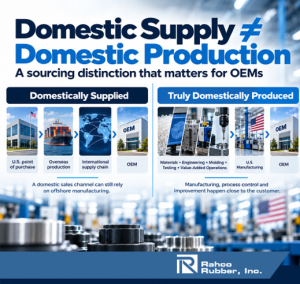 That gives OEM teams more direct access to the people responsible for material selection, tooling, process improvement, quality and production — rather than managing those issues across continents and multiple layers of a supply chain.
And when an OEM brings an existing component back to the United States, the goal shouldn’t simply be to reproduce it.
The opportunity is to improve it. OEMs should be asking:
Can we manufacture it better?
Can lead time be reduced? Can material performance improve? Can automation lower cost or variation? Can inventory requirements be reduced? Can secondary operations be integrated? Can quality and process control improve?
The 2026 reshoring data makes clear that more OEMs are asking those questions.
Rahco Rubber is ready to help answer them.
If you’re evaluating an offshore rubber component, Rahco can review the part, material, tooling and production requirements to help determine what true domestic manufacturing could mean for cost, performance, lead time and supply-chain reliability.